Psalm 1. CHAPTER 2. EATING FROM THE TREE OF LIFE
2.1 The good tree and the bad tree
In the flow of the psalm, we are told in Psalm 1:3 that the righteous man is like a tree. When we think about a tree, we cannot help but remember the first trees in the Garden of Eden. In Genesis 2:9 we are told that “Out of the ground Yahweh God made every tree to grow that is pleasant to the sight, and good for food, including the tree of life in the middle of the garden and the tree of the knowledge of good and evil.” God gives man access to eat from the tree of life, but from that forbidden tree He does not allow him to eat, because it is a false tree, one that only gives the impression that it is good (“When the woman saw that the tree was good for food, and that it was a delight to the eyes, and that the tree was to be desired to make one wise…” Genesis 3:6), yet in reality it is evil, because God tells him that “for in the day that you eat of it, you will surely die” (Genesis 2:17).
The tree of life is that tree in the middle of the garden from which flows the life of God, immortality, since He, God, has life in Himself, and He created human life. There was no death, sin, sickness, curse, pain, or sorrow in Eden until man broke the single command God had given him. And the moment he does, God drives him out of Eden to guard the way to the tree of life (Genesis 3:24), so that man could no longer reach it. It is a desolate and deeply discouraging picture, that man willingly disqualified himself from eating of the tree of life. From an Edenic landscape, the scene turns into death, groaning, tears, and suffering.
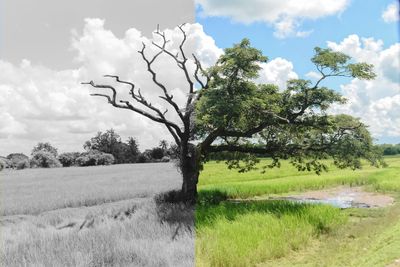
2.2 The Redeeming God and the rebellious people
But God desires to redeem man, not to leave him in this fallen state forever, so that he may once again have access to the tree of life. We see Moses meeting God in the burning bush (the little tree): “Moses looked, and behold, the bush burned with fire, and the bush was not consumed. He said: “Don’t come close. Take off your sandals, for the place you are standing on is holy ground.” Moreover he said, “I am the God of your father, the God of Abraham, the God of Isaac, and the God of Jacob. Moses hid his face because he was afraid to look at God” (Exodus 3:2,5–6). We find the same image here, the bush of life, the fire of holiness, and the presence of God from the midst of the bush, a presence once enjoyed by Adam and Eve in the cool of the day. But the invitation is for all the people of Israel to come and meet the tree of life, the God in the bush: “When you have brought the people out of Egypt, you shall serve God on this mountain” (Exodus 3:12b)
The people of Israel, however, choose false trees, the golden calf, the gods on the high places, the gods of foreign nations. They choose sin instead of Yahweh, their God, with whom they had entered into a covenant. God disciplines them, sends them among foreign nations, yet He has mercy on them and preserves a remnant to return from exile.

2.3 Christ, the tree of life and the new covenant
And so we arrive in the time of the Lord Jesus Christ, who says that He is the tree of life, the vine, from whom God’s life flows: “I am the true vine, and my Father is the farmer […] I am the vine” (John 15:1,5). On this tree of life, the Jews cut Him down; they thought they would get rid of Him, that they would throw Him into the fire. But Christ said that “unless a grain of wheat falls into the earth and dies, it remains by itself alone. But if it dies, it bears much fruit” (John 12:24). Christ died so that through His death He might overcome man’s eternal death and the devil, and the fruit of His death is life itself—it is the risen Christ, the tree of life, the source of eternal life, in a renewed sense, of a new covenant: “This is my body which is given for you […] This cup is the new covenant in my blood, which is poured out for you […] Do this in memory of me” (Luke 22:19-20). Therefore, Paul tells us that “if anyone is in Christ, he is a new creation. The old things have passed away. Behold, all things have become new” (2 Corinthians 5:17). And he also reminds us that “We were buried therefore with him through baptism into death, that just like Christ was raised from the dead through the glory of the Father, so we also might walk in newness of life” (Romans 6:4).
Therefore Christ is the Tree of Life, and we, those who have believed in Him, who have chosen Him, who have repented of our sins, have been buried together with Him and have received a new life, a new identity. “You were dead through your trespasses and the uncircumcision of your flesh. He made you alive together with him, having forgiven us all our trespasses” (Colossians 2:13). If before we were a bad tree, thinking and doing evil naturally and deliberately, now, through the seed of faith in Christ and through the Holy Spirit, we have become a tree according to the nature of the Tree of Life—that is, like Jesus Christ; we are that “much fruit” (John 12:24) of His death, which we spoke about a few lines above. In the well-known chapter Isaiah 53, in verses 10 and 11, it is written: “Yet it pleased Yahweh to bruise him. He has caused him to suffer. When you make his soul an offering for sin, he will see his offspring. He will prolong his days, and Yahweh’s pleasure will prosper in his hand. After the suffering of his soul, he will see the <<light>> [WEB] / <<travail of his soul>> [KJV] and be satisfied. By the knowledge of himself my righteous servant will justify many, and he will bear their iniquities” (Isaiah 53:10–11). These are we, the fruit of the travail of the soul of the Lord Jesus, the trees that resulted from His crushing on the cross, the trees with a new nature, grown from divine seed—“his offspring”—new people, in a state according to the will of God. We have not become the Tree of Life, but we are trees born from the Tree of Life.
After Adam sinned, “when Adam was one hundred thirty years old, he became the father of a son in his own likeness, after his image, and named him Seth” (Genesis 5:3). It is wonderful that God created Adam in His own image and likeness, but it is tragic that Adam fell through disobedience, and the one born from Adam bore his image and likeness—the likeness of sin. Yet, through the new birth, Christ transforms our inner nature, redeems us and now we show the world that through His death and resurrection He has restored what was destroyed in Eden, and that now we are once again sons and daughters in His image and likeness.

2.4 A place prepared in Paradise
The last page of the Bible reveals to us a new garden, a new Temple, a new city, with the tree of life at its center, like the garden of Eden in Genesis: “In the midst of the street of it, and on either side of the river [KJV] was the tree of life, bearing twelve kinds of fruits, yielding its fruit every month. The leaves of the tree were for the healing of the nations [WEB]” (Revelation 22:2). Jesus Christ ascended to the Father, into heaven, from where He came and where He returned to prepare a place for us: “In my Father’s house are many homes. If it weren’t so, I would have told you. I am going to prepare a place for you. If I go and prepare a place for you [...] I will come again and will receive you to myself; that where I am, you may be there also” (John 14:2–3). There, in the Father’s house, He is and remains the tree of life. Whoever eats from His leaves and from His fruit is healed, and at the end of days will be in the presence of Jesus Christ forever, in paradise.
